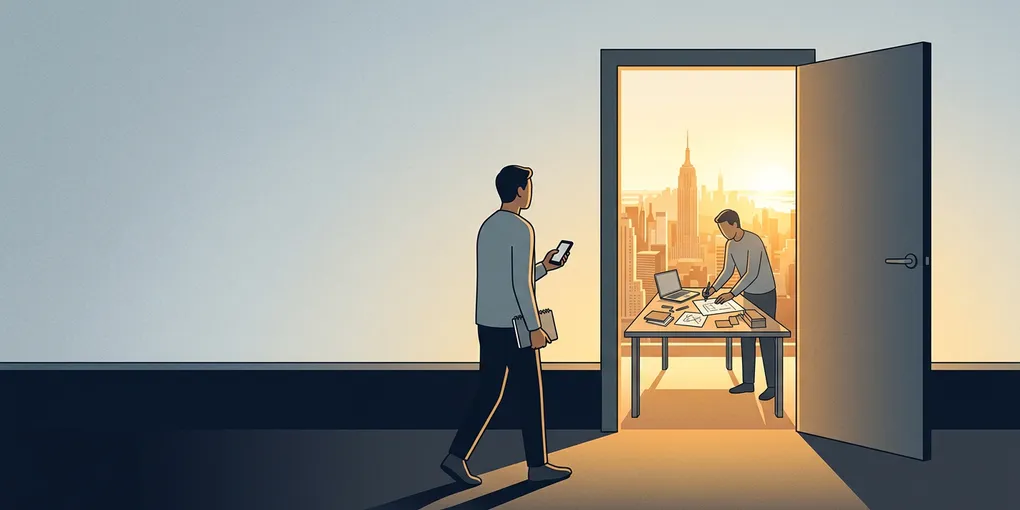
The Door is Already Open
It’s 2 a.m. and you’re looking at your phone in the dark, at a note titled “the idea.” You started it two years ago. You’ve opened it four or five times since, added a line, closed it again. It’s the problem you understand better than anyone who’s ever tried to solve it, because you’ve actually lived inside it.
If some version of guilt just showed up reading that, the two years, the four or five half-starts, I understand it. Most people carry a version of that note and feel a little bad about it. But guilt isn’t the point of this. The door in front of that idea, the one that used to be genuinely locked, is standing open right now, and few have fully realized what that means yet.
Approximately 1,530 words · 7 minute read
Published August 18, 2026
The Lock That Finally Broke
I would wager that for most of your adult life, that note stayed a note because the door in front of it really was locked. Building something took capital you didn’t have, credentials you weren’t handed, a network that would return your calls. So the idea sat there, safe and untouched, and you called it patience instead of what it actually was.
Somewhere in the last two years, without anyone announcing it, the lock changed, and not just for engineers. A nurse can now sketch out a scheduling system for her unit on her lunch break. A teacher can build a curriculum tool tailored to her classroom over a weekend, something that used to take a district’s IT department a semester to approve. A woman running a flower shop can build her own booking site, write a year of marketing emails, and understand her own sales patterns better than the accountant she used to pay for that. According to the Small Business & Entrepreneurship Council’s 2026 Small Business Tech Use Survey, 82% of small business owners have already put these tools to work, and most of them have no technical background at all. This is a story about people who finally have a research team, a design partner, and a tireless assistant available for the price of curiosity. For less than $300 a year, you can carry expertise that used to sit behind university gates right in your pocket, on call whenever a question stops you cold, no application, no acceptance letter, no tuition bill required. How many of you would have appreciated that tuition bill instead of the one you likely received?
More than 6 billion people are online right now, and over a billion of them use some kind of AI tool every month, most without ever writing a line of code. The largest, fastest-built support system for individual ambition that has ever existed. And you were born early enough to use it. Over 2 billion people are still offline, concentrated in parts of Southern Asia and Central Africa, and closing that gap matters. But if you’re reading this on a phone at 2 a.m., the door in front of you isn’t locked. It hasn’t been for a while. You just haven’t tried the handle.
No Idea Yet? Good. Start Looking.
Maybe none of this landed the way it was supposed to, because you don’t have a note. No five-year itch, no problem you’ve been quietly circling, no idea waiting for permission. That can feel worse than it should, especially reading something like this, surrounded by people who apparently know exactly what they want to build. If that’s you (and candidly myself included) you haven’t missed anything, and there’s nothing wrong with you for not having it yet. You just haven’t gotten to that part, and that’s a fine, ordinary place to be standing.
Some of the most important things anyone has ever built didn’t start as a fully formed idea. They started as a question. An afternoon spent poking at something that seemed mildly interesting for no particular reason. A walk where one small observation refused to leave you alone. The idea usually doesn’t arrive first. The looking comes first, and the idea shows up somewhere in the middle of it, almost always while you’re paying attention to something else.
The same shift that made building cheap also made exploring cheap. Following a curiosity for an afternoon used to cost a semester of tuition or a favor from someone who knew more than you. Now it costs an evening and a willingness to ask an obvious question out loud. You can try ten small, half-formed things in a weekend and let nine of them go nowhere, because none of them cost you anything you couldn’t spare. That kind of open-ended searching used to be a luxury reserved for people with time and money to burn. It isn’t anymore.
So go looking, on purpose, even without a destination. Follow the thing that’s mildly interesting for reasons you can’t fully explain yet. Ask the question that doesn’t seem important. You don’t need the note tonight. You need the willingness to eventually open one, whenever it shows up.
Meet Who You Become
Picture it. Not the idea anymore, the thing itself, built, working, out in the world. Someone you’ll never meet finds it at their own 2 a.m., the way you found this. It solves the exact problem you used to complain about. They don’t know your name. They just know it works, and it makes their week a little lighter.
You did that. Not a company, not a committee, but you and a laptop, a real problem you understood better than anyone, and the nerve to finally open the note instead of closing it.
That version of you isn’t hypothetical anymore. It’s maybe only one weekend away.
A single person, with the right idea and the tools sitting on their phone right now, can research a problem the way a small institute used to, design a solution the way a studio used to, and put it in front of real people the way a funded startup used to. The clinic you wish existed in your neighborhood. The tutoring program for kids who fall through the cracks. The tool that would’ve saved you a year of confusion when you started out. None of it is out of reach because you’re one person. Being one person who’s actually lived the problem might be the best position to build from that’s ever existed.
Carta’s data on new startup formation shows the share founded by a single person climbing from 31% in 2024 to about 36% in 2025, roughly double what it was a decade ago. Ordinary people. Deciding their idea was worth trying. Finding out it was more possible than they thought.
You Were Built for This
The tools don’t do the work for you, and that’s the good part. What’s changed is how much it costs to start, not how much it costs to finish. Seeing something through still takes the same grit it always has, the late nights, the version eight that finally works, the willingness to keep going after the excitement wears off. None of that got cheaper. Only the starting line moved.
Information without curiosity is just noise with better formatting. What makes an idea good was never going to come from a model. It comes from you, from having lived close enough to a problem to know what matters and who it actually helps.
This moment calls for explorers. People curious enough to chase a real question past the first easy answer, and empathetic enough to build something that genuinely serves the person on the other end of it. Pair that with tools this capable, and there’s very little left standing between a real idea and a real version of it in the world.
Curiosity looks like asking “why” one more time than feels comfortable, chasing the answer even when the easy version would do. Empathy looks like showing your rough draft to the actual person it’s for and changing your plan because of what they say, even when it’s not what you wanted to hear, and even when it stings a little to hear it. That sting is normal. It usually means you’re close to something real. Neither curiosity nor empathy shows up in a press release. Both of them are the entire difference between something that gets used and something that just gets built.
William Gibson once put it this way:
“The future is already here — it’s just not very evenly distributed.”
For most of history that line described a velvet rope, the cutting edge sitting just out of reach for anyone without money or a name that opened doors. That’s reversing. Toward you, and everyone else who thought their idea would have to wait.
Walk Through
Forget the plan. Forget the perfect version. It’s okay to be scared of the rough one, most people are. Go build it anyway, tonight or this weekend, and let it be messy, because messy and real beats polished and imaginary every time.
The version of you who built the thing is standing right there on the other side of that door, waving you through.
Go meet them.