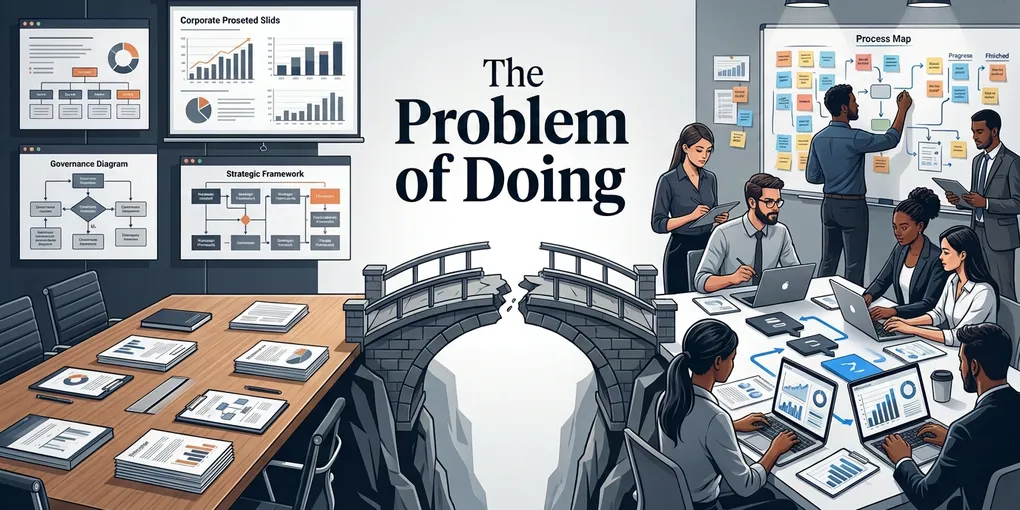
The Problem of Doing
Picture a scene most of you have lived through at least once.
An organization spends six months building a strategy. There are workshops. A consultant or two. A framework with a name that sounds like an acronym someone is quietly proud of. A deck gets presented to leadership with real conviction. Everyone nods. The document lands on the company intranet. Then, almost imperceptibly, nothing changes.
Not because the strategy was wrong. Not because the people were lazy or indifferent. But because somewhere between the plan and the doing, the organization quietly ran out of will.
This pattern is everywhere. It shows up in corporations, nonprofits, government agencies, healthcare systems, small teams, and individual careers. The context changes. The pattern does not.
There is a name for it. The problem of doing. And it represents one of the most significant untapped opportunities in professional life right now.
The Gap Is Real and the Upside Is Enormous
PMI’s December 2025 Step Up report surveyed 300 senior executives and found that the top barrier to reinvention, cited more than any other factor at 35%, was a disconnect between planning and execution. Not a lack of ideas. Not a lack of capital. Not a lack of technology. The gap between the plan and the doing.
The gap is not between bad strategy and good strategy. It is between strategy and reality.
Organizations that close the execution gap are three times more likely to report above-average growth and twice as likely to achieve above-average profits. The performance advantage is structural. Most organizations are leaving it entirely on the table.
There is something more specific happening beneath that gap. It is not just that organizations fail to act on their strategies. It is that the things built to enable action, the platforms, the governance models, the policy frameworks, the oversight committees, quietly become the destination instead of the vehicle. The means becomes the end. The scaffolding gets mistaken for the building.
The platform was supposed to be how value got driven. Somewhere along the way, building the platform became the value. The governance framework was the vehicle. Completing the governance framework became the finish line. This happens so gradually that most organizations do not notice until someone asks what actually changed for the people the work was meant to serve.
The organizations willing to ask that question first are the ones positioned to win.
The Psychology Underneath It, and the Three People It Lives In
There is a reason this keeps happening. Building things feels productive. Designing a framework, standing up a governance structure, drafting a policy, these activities generate real outputs, real meetings, real deliverables. They create the sensation of forward motion without any of the exposure that comes from putting something in front of real conditions. When the platform is being built, nothing has been tested. Nothing has failed. The possibility of success remains perfectly intact.
Psychologists Daniel Kahneman and Amos Tversky called this the planning fallacy: the tendency to consistently underestimate the time, costs, and risks of future actions while overestimating the benefits. Organizations do not just tolerate this tendency. In many cases they reward it. The person who produces the beautiful deck gets recognized. The person who quietly changes something real for actual people often does not.
The problem of doing lives in specific people making rational choices inside systems never designed to reward action. Three characters show up in almost every stalled initiative, in any organization, in any sector.
The Planner has built a career on producing elegant frameworks. Visibility, performance reviews, and next opportunities all flow from the quality of what gets built, not from what it ultimately changes. Putting a framework in front of real conditions is a risk that carries no personal upside. The governance model, as long as it stays in design, cannot fail.
The Approver keeps asking for one more revision, one more round of alignment, one more stakeholder briefing. Moving forward means being accountable for outcomes. Waiting means the framework is still perfectible. For someone who has learned that organizations punish failure more consistently than they reward initiative, keeping things in refinement is a perfectly sensible personal strategy.
The Team has watched this movie before. They remember the last platform that arrived with fanfare, got built, got documented, got handed over, and then sat largely unused six months later with no honest explanation of why. Gartner research found that only 38% of employees are willing to support organizational change today, down from 74% in 2016. That drop did not happen because people got lazier. It happened because people learned.
None of these are character flaws. They are human responses to organizational incentives. The good news is that incentives can change. When they do, these same people become the most powerful force for getting things done.
The Other Failure Mode: When There Is No Plan at All
Over-planning is not the only way organizations fail. The opposite instinct kills just as many initiatives. It just does it faster and more loudly.
Some organizations, and some leaders, have a genuine allergy to planning. They see frameworks as bureaucracy and governance as delay. Their default is to identify an opportunity and charge directly at it. No map. No capacity check. Just momentum and conviction.
Those rooms are genuinely energizing. They are also frequently chaotic in ways that take months or years to untangle.
Research from the Strategy Institute shows that organizations pursuing more than five strategic priorities simultaneously see a 30% drop in execution effectiveness compared to those maintaining sharp focus. When everything is a priority, nothing is. Resources get spread thin. Teams receive conflicting direction. People work hard in different directions and produce friction instead of progress.
The over-doer creates specific damage worth naming. Money gets committed before anyone has defined what it is buying. Budgets expand to meet the urgency of the moment rather than the requirements of the goal. MIT Sloan researchers documented in 2025 that overloaded organizations consistently find their highest performers absorbing the most additional work, accelerating the very burnout they are trying to outrun. The team learns the same lesson they learn from the over-planner: what gets announced is not necessarily what gets done. Trust erodes either way.
The over-planner’s failure is visible in documents that collect dust. The over-doer’s failure is visible in people who leave. Both are expensive. The over-doer’s tends to be harder to trace back to the decision that caused it.
The problem of doing is not solved by removing all structure. It is solved by finding the line between enough direction to focus energy and so much process that the energy never gets spent.
AI, Disruptive Technology, and a Pattern That Keeps Repeating
The problem of doing is not new. What is new is the price of repeating it.
This same pattern has played out across every major wave of disruptive technology for decades. 70% of all software implementations still fail due to poor user adoption, and 47% of ERP implementations experience budget overruns averaging 35% over plan, not because the technology did not work, but because the organizations deploying it never changed how they operated to use it. The cloud wave, the data lake era, the digital transformation decade, each one produced its own version of the same story: enormous investment, impressive infrastructure, and a gap between what was built and what actually changed for people doing real work.
AI is not different. It is the same pattern at a larger scale, with a shorter feedback loop and a much bigger bill.
MIT’s NANDA research found that 95% of generative AI pilots failed to deliver measurable P&L impact. 88% of enterprise AI pilots never reach production at all, according to IDC. The share of enterprises abandoning most of their AI initiatives jumped from 17% in 2024 to 42% in 2025, according to S&P Global. Gartner now predicts that over 40% of agentic AI projects will be cancelled by the end of 2027.
There is even a name for where most AI initiatives end up. Researchers and analysts now call it pilot purgatory: the state where a project has cleared initial testing, produced an impressive demo, received approval to scale, and then stopped. Not cancelled. Not shipped. Permanently almost. According to Deloitte’s 2026 State of AI in the Enterprise report, organizations that cycle through repeated failed pilots develop what researchers are now calling pilot fatigue, a progressive loss of institutional appetite and capability for the very transitions that would generate value. By the third stalled initiative, executives stop attending reviews. By the fourth, the organization has lost the cultural muscle needed to make the transition work.
The recurring diagnosis across all of this research is not the technology. Analysis consistently points to organizational dysfunction, unclear ownership, and the absence of workflow redesign as the primary causes of AI failure, not model quality or data complexity. Organizations are treating AI deployment like a software upgrade: install, configure, train users, go live. It is not. It is an operational and behavioral transformation. The technology is often the easiest part.
McKinsey’s 2025 State of AI data makes this visible in a single number: only 21% of organizations using generative AI have actually redesigned their workflows around it. The remaining 79% are layering AI on top of unchanged processes and then wondering why the return on investment does not materialize.
The strategy exists. The governance framework exists. The center of excellence exists. The responsible AI policy is drafted and approved. The results, for most organizations, still do not exist. This is not a technology failure. It is the vehicle becoming the destination, at a scale and cost that is now impossible to ignore.
What the People Who Get It Right Actually Do
The organizations that thread this needle are not the ones with the most elaborate plans or the most fearless cultures. They are the ones that have learned to distinguish between structure that enables action and structure that replaces it.
They ask the question nobody asks. What has actually changed for the people this was built to serve? Not whether the platform got built. Not whether the policy got approved. What is measurably different for the person on the other end of it? That question, asked honestly and regularly, cuts through both over-planning and over-doing.
They start before everything is ready, but not before they know where they are going. There is a meaningful difference between starting before a plan is perfect and starting without one. Real conditions teach things no planning session can. The goal is to move into reality early, carrying enough direction to know what is being learned.
They hold themselves accountable for what changed, not what they produced. The policy document is not the work. The governance framework is not the work. What is different in practice, for real people, because those things exist, that is the work.
They close things before they open new ones. Before asking people to invest in what is next, they honestly name what the last thing actually did. What worked, what did not, and what changed for the people it was meant to reach. Almost nobody does this well. The people who do tend to still have the trust of their teams when it matters most.
Research consistently shows that the organizations that outperform are not those with the most brilliant strategies or the boldest cultures, but those that execute most effectively. That advantage does not require a new framework. It requires a clearer answer to a simple question.
Is this the vehicle, or has it already become the destination?
What does this pattern look like in your world, and what has actually made the difference when you have seen it break?